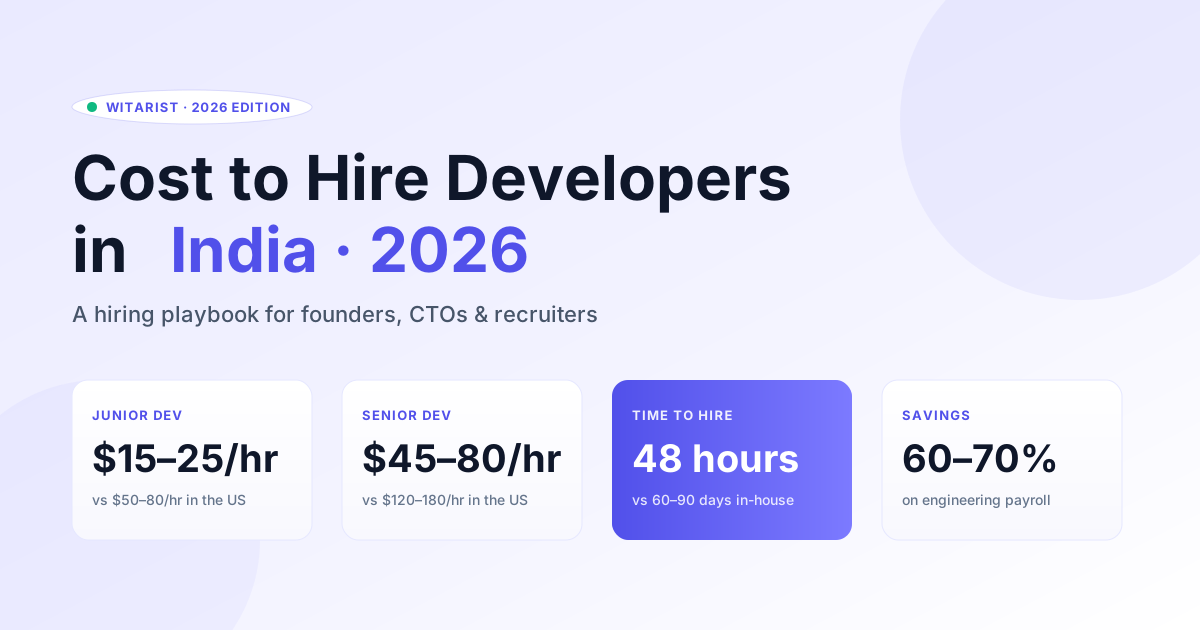
TL;DR for hiring managers: In 2026, hiring a software developer in India costs $15–$80/hour depending on stack and experience — roughly 60–70% less than the US equivalent. Through staff augmentation, you can have a pre-vetted developer in your standup in 48 hours instead of the 60–90 days a traditional in-house hire takes.
If you're a founder shipping an MVP, a CTO scaling a backlog, or a recruiter filling a sprint-critical seat, the question isn't whether to look at India — it's how much you'll actually pay, how fast you can onboard, and where the hidden costs hide. This guide answers all three with current 2026 rate ranges, real timelines, and a hiring model decision framework you can forward to your CFO.
Witarist runs a vetted talent network of 1,100+ developers across 50+ tech stacks. The numbers below come from our own placements plus public benchmarks (Stack Overflow Developer Survey 2024, NASSCOM, Glassdoor, PayScale).
2026 rate card: what an Indian developer actually costs
Indian developer rates split cleanly along four lines: experience, stack, city, and engagement model. Here's the at-a-glance comparison most CTOs ask us for in the first call.
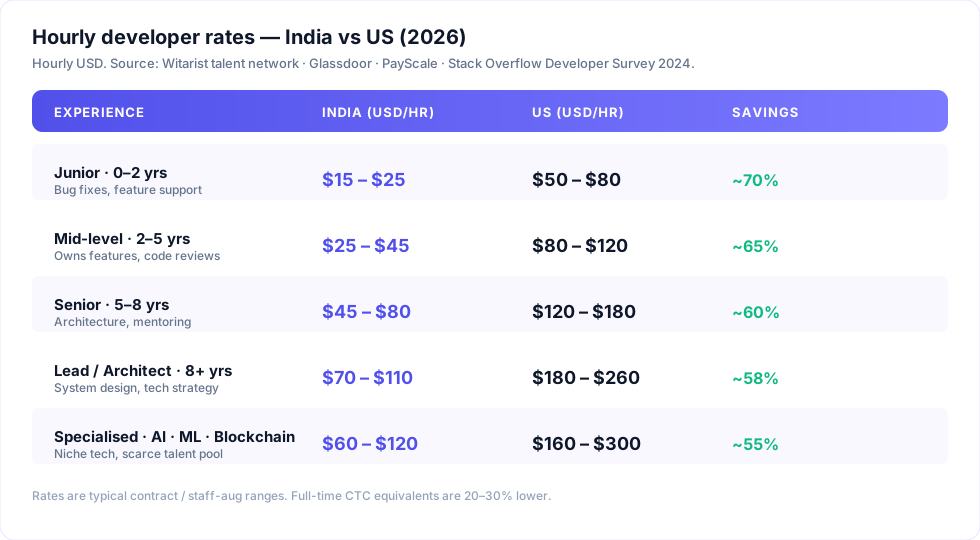
Two patterns to notice. First, the savings widen at the senior end — the absolute rupee gap between a US senior and an Indian senior is much larger than at junior. Second, specialised stacks compress the gap: niche AI, ML, and blockchain talent in India still costs ~55% less than the US, but the dollar number per hour is rising fast as global demand outpaces local supply.
The 6 factors that move a developer's price tag in India
1. Years of experience (and what they actually deliver)
A 2-year backend engineer can ship a CRUD API. A 7-year senior can design the system that keeps it from melting at 100k QPS. The price difference reflects the gap. Use this rough heuristic when scoping a role:
- Junior (0–2 yrs) — bug triage, ticket execution, paired feature work.
- Mid-level (2–5 yrs) — full feature ownership, code reviews, on-call.
- Senior (5–8 yrs) — architecture, mentoring, performance work.
- Lead / Architect (8+ yrs) — system design, tech strategy, hiring panels.
2. The technology stack you need
Mainstream stacks have deep talent pools and lower rates. Specialised stacks have shallow pools and rate inflation. Approximate 2026 hourly ranges for a senior India-based developer (staff augmentation):
- React.js / Next.js developers — $40–70/hr. Largest pool in India, fastest match times.
- Node.js developers — $40–70/hr. The default backend pairing for most JS-first stacks.
- Python / Django developers — $45–75/hr. Premium for ML, data, and FastAPI experience.
- Java / Spring Boot developers — $45–80/hr. Strong for enterprise, fintech, and high-throughput APIs.
- Full-stack (MERN/MEAN) developers — $50–85/hr. The go-to profile for sub-15-engineer startups.
- DevOps / SRE engineers — $55–95/hr. Kubernetes + Terraform pushes to the top of the band.
- AWS / cloud architects — $60–100/hr. Solutions-architect certification adds 15–20%.
- React Native / Flutter mobile devs — $40–75/hr. Cross-platform experience commands a premium over native-only.
Need a stack we didn't list? Browse the full Witarist technologies catalogue — 50+ stacks with live developer counts and starting rates.
3. City within India
Tier-1 cities (Bangalore, Hyderabad, Pune, Mumbai, Delhi/NCR, Chennai) carry a 15–30% premium over Tier-2 cities (Jaipur, Indore, Coimbatore, Kochi, Ahmedabad). The premium reflects two things: density of senior talent, and competition from product companies. For most staff-aug roles you don't need to pay the Tier-1 premium — remote-first delivery flattens the gap.
4. Engagement model
Hourly contract, monthly retainer, fixed-price project, or full-time dedicated developer — each model trades flexibility for predictability. We unpack the trade-offs in the next section.
5. Urgency premium
"Need someone in 48 hours" costs more than "need someone in 30 days." Pre-vetted networks like Witarist don't charge a panic premium — but generic marketplaces will. Expect a 10–20% urgency surcharge if you're sourcing on a 1-week timeline through a non-pre-vetted channel.
6. English fluency, time-zone overlap, and soft skills
Pure technical skill is the floor. The variance you actually feel as a manager comes from English fluency, async writing, time-zone overlap with your standup, and ability to push back on a bad spec. Pre-vetted platforms screen for this; freelance marketplaces don't.
Hiring model showdown: freelancer vs staff augmentation vs in-house
Three viable paths to get an Indian developer into your team. They differ on cost, speed, risk, and how much HR overhead you absorb.
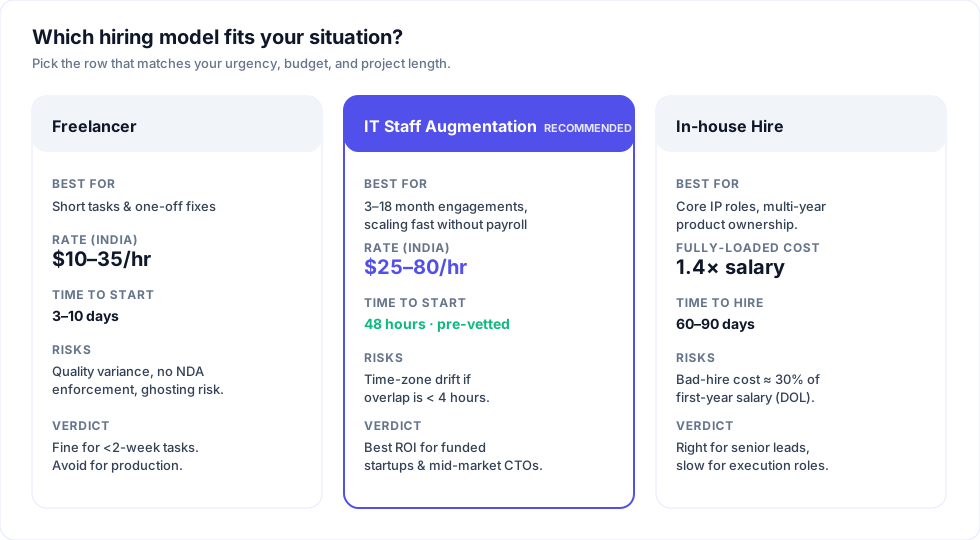
For most Series A–C startups and mid-market scale-ups, IT staff augmentation is the highest-ROI path. You skip the 60–90-day in-house process, dodge the bad-hire risk, keep payroll lean, and still get a developer who attends your standup, uses your Jira, and ships against your sprint goals.
How fast can you actually hire?
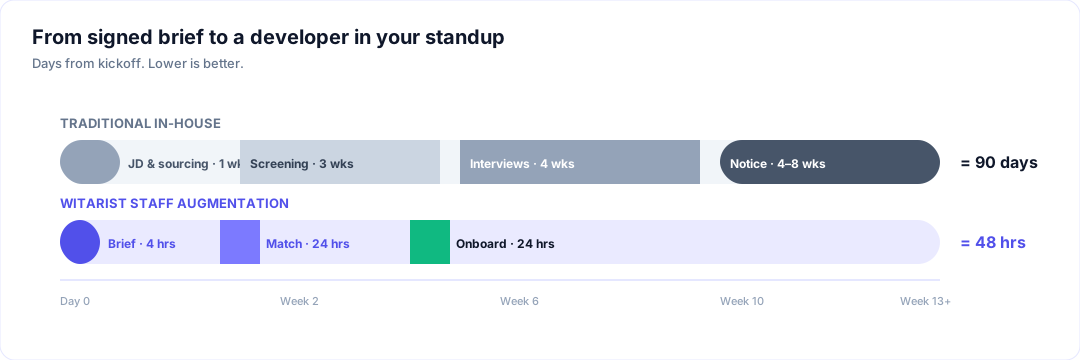
This is where the real cost lives. Every week your role sits open is engineering velocity you don't ship. For a Series A startup burning $200k/month, a 90-day hiring delay isn't a $0 line item — it's two-thirds of a runway month gone.
Hidden costs founders forget when budgeting an India hire
The hourly rate is rarely the total bill. Add these:
- Recruiter fees: 8–25% of first-year salary if you're going through agencies; $0 with most staff-aug providers.
- Bad-hire cost: the U.S. Department of Labor pegs a wrong hire at ~30% of first-year salary in lost productivity, severance, and rehire cycles.
- Onboarding ramp: a fresh hire takes 3–6 months to reach full productivity. A pre-vetted contractor with similar codebase experience hits productivity in 2 weeks.
- Compliance: payroll, EPF, gratuity, GST, and state-level rules. Staff-aug providers absorb these; direct hires force you to set up an Indian entity or use an EOR.
- Tooling and licences: $50–$200 per seat per month for IDEs, observability, design tools, and cloud sandboxes.
- Time-zone friction: plan for 4 hours of overlap minimum. With Indian Standard Time, a US East Coast team gets a comfortable 9:30 am – 1:30 pm IST window; West Coast gets 7:30 pm – 11:30 pm IST. Workable, but worth budgeting for async tooling.
What "pre-vetted" actually means at Witarist
Every developer in our placement pool clears a 4-stage screen before their profile reaches you:
- Code & system-design assessment — live coding, take-home, and architecture whiteboard scored against rubric.
- Communication screen — English fluency, async writing samples, and a 30-minute scenario interview.
- Background and reference checks — last two employers verified, education credentials confirmed.
- Cultural / async-fit panel — how they handle ambiguous specs, push back on bad PRs, and write ADRs.
Roughly 1 in 28 applicants makes it through. That's the bar — and it's why the average time-to-first-match is under 48 hours: when a brief lands, we're matching from a pool that's already been screened, not from a cold pipeline.
When hiring in India is the wrong call
Honest answer for hiring managers — India isn't always the right move. Skip an India hire when:
- You need 8+ hours of overlap with a US Pacific team for live pairing.
- The role requires on-site access to physical hardware or a US-based SCIF / cleared-personnel environment.
- Your client contract explicitly requires US-only or EU-only personnel (defence, some healthcare, some government).
- You're hiring a founder-track engineer who needs equity treatment that's awkward across borders.
- For everything else — product engineering, platform work, mobile, data, DevOps — India is the most cost-efficient path that doesn't compromise on quality.
The 48-hour Witarist hiring playbook
If you're a hiring manager who needs a developer this week, here's the exact path most clients run:
- Day 0 — 30-minute scoping call. Stack, seniority, time-zone overlap, budget, and start date. We translate that into a 1-page brief.
- Day 1 — three matched profiles. CVs, recorded coding samples, and Loom-style intros. You shortlist 1–2.
- Day 2 — your interview. 60 minutes with your tech lead. We pre-warm the candidate on your stack so the conversation is signal-rich.
- Day 2–3 — onboarded. Contract, NDA, and access provisioning handled by us. Developer joins your standup. You pay only after onboarding.
The bottom line for hiring managers
Hiring a software developer in India in 2026 isn't an offshoring decision — it's a velocity decision. The best companies use staff augmentation to compress 90 days into 48 hours, keep engineering payroll 60–70% lighter, and only commit to in-house headcount once a role is permanent strategic IP.
If you're hiring this quarter, the question isn't whether the rates above match your budget. It's how much velocity you're losing every week the role stays open.
Need a developer in 48 hours? Tell us your stack, seniority, and start date. We'll send three matched, pre-vetted profiles within 24 hours — zero upfront cost, zero recruiter fees.
Related reading
Browse more hiring guides: Hire React.js Developers, Hire Node.js Developers, Hire Full-Stack Developers, Hire AWS Developers, or browse our full technologies catalogue.